


The job of access control systems should be to allow entry and exit to a building for security purposes. But in the post-COVID-19 world, electronic access control systems have taken on more responsibilities, including disease prevention and control. This article identifies and explores key access control technology trends for 2021 that we believe will continue to be impacted by the :pandemic. In this article, we will continue to explore these trends
4. Growing focus on mobility and mobile access control

Mobile authentication, where a user uses their mobile device to unlock doors, has become an increasingly popular access control technology. Recent research by HID Global reports that the adoption of mobile access continues to grow; 25 percent of organizations have fully or partially implemented these systems. In fact, since card keys can be easily stolen and are much more expensive to manufacture, the use of mobile devices makes sense, especially in institutions such as offices and large campuses where it is very expensive to manufacture and issue cards to everyone. The use of mobile authentication systems will continue to grow and expand in both legacy and new access control solutions; in terms of market segments, higher education and shopping malls, these locations will see a significant increase in the adoption of mobile authentication systems.
And let’s not forget that COVID-19 has created a demand for contactless and mobile access control systems; mobile access control systems fit the bill. The focus on mobility isn’t going anywhere for a while, so we’ll continue to see the wider use of mobile authentication systems that expand contactless/frictionless access control solutions. Before COVID-19, the common practice for contractors and clients visiting many businesses from outside was to direct them to a reception desk or request access in person. As the pandemic spread and organizations looked to limit the risk to employees (as well as shift to more remote working), the implementation of mobile authentication systems became a reality.
5. Contactless biometrics
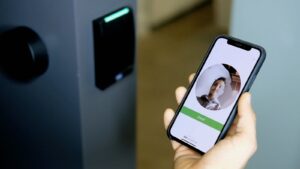
Speaking of contactless systems, it is true that fingerprints are still the primary biometric for access control, but they have their own drawbacks; for example, health concerns and slower adoption. Now, with the COVID-19 virus, where touching things has been cited as a medium for transmission, contactless biometrics are becoming a more powerful access control technology trend. The need to support contactless experiences to access and move through physical environments will force the industry to adopt existing and new technologies and solutions. Seamless, contactless, and frictionless are among the key features of the experiences that the market will demand moving forward.
Needless to say, contactless access control systems have been one of the buzzwords of the day in 2020. We have seen many new vendors enter the space due to the simplicity of supply and demand. We have seen a steady growth in the market due to the increased accuracy and convenience that contactless systems offer in user identification. We do not believe that the market for contactless access control systems was created all of a sudden, but rather the “acceptance” of the technology has been a significant and timely driver of its success.
For example, it is interesting how the experience of a contactless guest management system can be completely hands-off throughout the entire process of requesting an appointment, registering yourself, and checking in. This sequence is actually very similar to what would be required in a “contactless” access control system, where everything is preferably done online. This could mean registering users and visitors online (e.g., facial recognition) and obtaining approval via their mobile phones, and then accessing the main entrance or other areas of the facility. Therefore, with these similarities, the integration and integration of these systems for non-human interactions will become even more essential.
Facial recognition systems can also now be integrated with various technologies to more effectively combat the COVID-19 virus. We are even seeing facial recognition devices that use the power of intelligence to detect whether a person is wearing a mask or not; or, using sensor technology, these devices can detect who has a high body temperature and thus restrict access until further screening of this group of people. In 2021, demand in these areas will grow as this contagious virus continues to be a major concern worldwide.
6. Continued demand for cloud access control systems after COVID-19

Like video surveillance-as-a-service (VSaaS), access control-as-a-service (ACaaS) has also seen growth. The COVID-19 pandemic is expected to accelerate this trend in access control technology even further, due to the various benefits it offers. First, unlike electronic access control systems that require servers, wiring, and licensing costs, ACaaS requires less upfront costs and instead charges a subscription fee based on user needs – a feature that could be attractive to end-users who are struggling financially due to the coronavirus. Since the data provided is stored centrally in the cloud rather than on local devices, there is less need to schedule on-site system maintenance; repairing on-site systems requires a site visit and may be counterproductive to virus control guidelines. Finally, with the help of cloud systems, some operations, such as issuing and revoking licenses, can be performed remotely rather than on-site, which is beneficial for adhering to social distancing guidelines.
7. Cybersecurity and identity management

Cybersecurity has also emerged as a key access control technology trend that will continue into 2021. Two factors are driving this trend. First, the devices in electronic access control systems are increasingly online and more vulnerable to data breaches than ever before. Second, with COVID-19 now sending employees around the world to work from home, secure, remote access tocorporate resources is more important than ever
Taken from a&s magazine