

It may seem hard to remember a time before people’s every move was monitored and controlled by network cameras. According to the British Security Industry Association (BSIA), there are now more than 5.9 million network cameras in the UK. Whether you’re in a supermarket, driving your car or walking down the street, there’s always a chance you’re being watched by a camera.
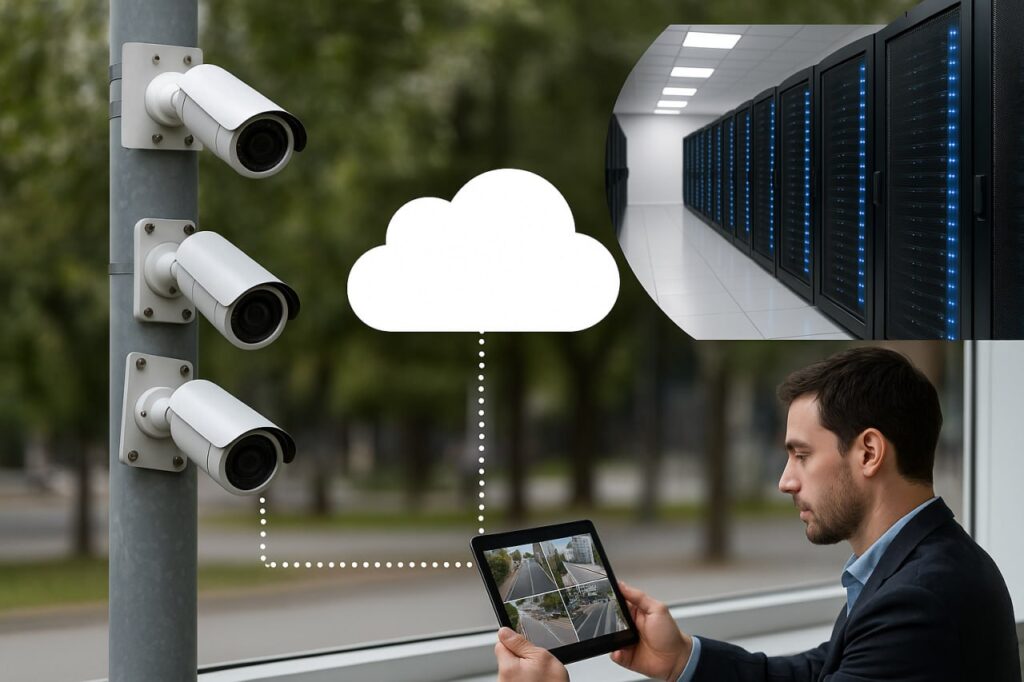
However, the days of sitting in a dark room watching hours of live video of your movements stored on dusty servers are long gone. Nowadays, most of the data captured on the footage is automatically stored in the cloud in a remote, highly secure data centre, ready to be played back on any device – from a tablet and mobile phone to a web browser. This allows organisations of all sizes to deploy the most suitable and cost-effective system available, minimising infrastructure costs and simplifying installation.
This process is also known as video surveillance as a service (VSaaS). According to a recent report by Transparency Market Research, the market is expected to reach $48.32 billion by 2020. The advantage of a hosted solution is that organizations can spend time on their core business while retaining all the features of a legacy video surveillance system. These features include: reviewing recorded video, receiving alerts when events occur, and remotely accessing cameras from anywhere with an internet connection.
Growing concerns about security and safety, theft, traffic monitoring, and government regulations have fueled the growth of video surveillance as a service (VSaaS) technology. While networked systems are an established tool for detecting damage, theft, intrusion, and natural disasters, it is often too late to view recorded video footage after an event has occurred. Video surveillance as a service technology allows businesses to monitor their environment, respond quickly, control conditions, and reduce financial losses.
This is done not only through remote storage, but also through a suite of video analytics applications. These applications help organizations proactively deploy video surveillance systems on-site and in locations that were previously prohibitively expensive to deploy. This allows businesses to monitor their environment, react quickly, control conditions, and reduce financial losses.
These applications can go beyond providing proactive monitoring and gather valuable business intelligence. For example, retailers and large event facilities such as concert venues can use analytics to monitor customer traffic. Typically, cameras are located above entrances and quickly monitor customers via a network every hour, every day, or every week. The ability to accurately monitor the traffic of people in a location allows businesses to improve customer service, measure the effectiveness of marketing campaigns, and predict the number of employees needed.
These analytics also have the ability to detect line crossings; Moving subjects crossing a designated virtual line are detected and an automatic alert, email or SMS is triggered when such an event occurs. Lane crossing detection increases system performance by reducing bandwidth and memory requirements and can be installed in most indoor and outdoor spaces and in varying lighting conditions. The system is suitable for many situations such as video surveillance of building entrances, loading docks and parking lots.
Video
Digital auto tracking detects and tracks moving subjects such as people and vehicles, eliminating the need to monitor multiple screens. This application is ideal for monitoring low-traffic areas such as parking lots, museums and monitoring during school hours, stores and construction sites. These are just a few examples of the wide range of applications that enable cameras to detect and capture events and eliminate the need to search through hours of recorded video.
The number of users and the breadth of analytics capabilities will undoubtedly grow significantly in the coming years, especially as the video surveillance as a service (VSaaS) market expands beyond North America and Europe to include countries such as Japan, China, and India. While the transportation and retail sectors are expected to remain among the largest users, it’s no surprise that VSaaS technology will become the video surveillance standard of the next decade as organizations strive to prevent crime and contain business losses.
Source: Capita Magazine