

Over the past year, security vendors have been involved in complex projects across multiple markets, with the end user’s goal being to address both security and non-security needs – such as improved processing and performance.
Retail

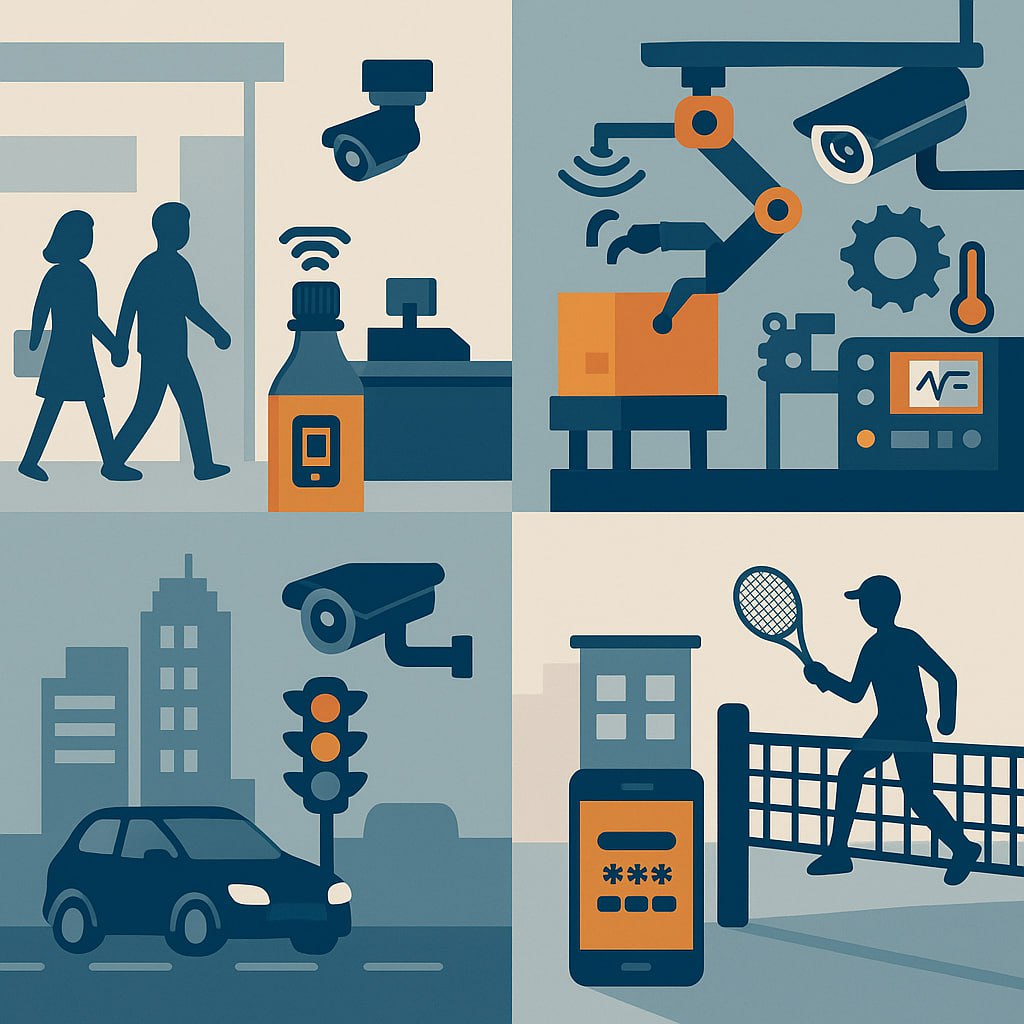
For example, in the retail sector, store owners now have a pressing need to understand their customers’ behavior patterns so they can optimize their store layouts and provide a better shopping experience in an increasingly competitive environment. In this context, various types of video analytics, from people counting to queue management, can be useful. Video integrated with point-of-sale (POS) devices can help retailers understand how many of a customer’s visits to a store actually resulted in a purchase, and thus come up with better sales and marketing strategies.
There are also integrated solutions that can attract more customers to their products. Retailers can improve their work by partnering extensively with companies that manufacture special bottle caps. For example, one company has been able to produce smart caps that are equipped with NFC technology. The idea behind this is to allow customers to get more attention for their product or that bottle of drink. Customers can place their Android or iOS phone on the bottle cap and easily record their purchase and receive special discounts. This means using technology to attract more customers, and it’s a win-win for everyone.
Public Services/Production

Next is the utility and manufacturing sector, where operators are increasingly relying on video integrated with other factory automation systems for quality control and preventive maintenance.
Today, utilities are beginning to use thermal security cameras for perimeter protection, as well as radiometric thermal cameras integrated with common temperature software for preventive maintenance. The data obtained from this software allows facility managers to remotely inspect and inspect equipment and identify any overheating risks before they are shut down. The result is significant savings for the customer.
In one particularly challenging application, a surveillance system had to be integrated with remote-controlled overhead cranes so that operators could accurately coordinate video images as events occurred and the cranes were operating. In this case, the cameras had to be aligned with the system’s laser location and the entire new system had to be deployed within the limited 20-day window allocated for the annual site overhaul. Now, as an operator controls the crane, the system automatically switches camera angles between preset settings, while the IP video transmission in real time allows the crane to be operated in the best possible way without any delays. In addition to improving performance and safety, this means that all processes are now supported by a complete video control group.
Transportation/Smart City

In the transportation sector, safety equipment is often used to smooth traffic flow or perform other management tasks. For example, cameras integrated with a traffic management system can enable self-adjusting traffic lights to change the length of red or green lights according to current traffic conditions, or help operators better plan transportation schedules. We are already seeing examples of cities using thermal cameras alongside traffic management software to improve mobility. While thermal cameras identify vehicles, the software analyzes statistics on destinations, travel times, and arrival times at red or green lights. All of this data helps cities understand traffic patterns and congestion, so they can take steps to improve traffic flow.
Location management
 Gradually, access control systems can be combined and integrated with other technologies to improve management in addition to enhancing security. Recently, a security company used its cloud-based access control system and video management solution to help the Lawn Tennis Association (LTA). The association wanted to make the most of its facilities by allowing the maximum number of people to enter its tennis courts each day. That cloud-based solution was integrated with a platform called ClubSpark, a venue management tool from Sportlabs (ClubSpark). The platform allows for a simple process to book tennis courts while also allowing users to remotely monitor the status of doors within a specific building (or chain of buildings). Tennis players use the ClubSpark platform on their smart devices to make reservations and pay for them, and then receive a text message with a PIN code that is sent to the access control solution. When players arrive at the tennis court, they enter that code on their device and Then the entrance door to the land there opens.
Taken from a&s magazine

Artificial Intelligence, Security, Security Solution, Retail, Smart City, Transportation Monitoring, Smart Manufacturing Technology, Analytics, Video Analytics, 3D People Counter, NFC, Perimeter, IP Camera, Network Camera, CCTV, Network CCTV, Thermal Camera, Video Surveillance, Network Surveillance, Transmission, Traffic Management, Access Control Systems, Access Control, Cloud, Cloud Service