
One of the important issues that is often overlooked in the design of video surveillance systems is the trade-off between image resolution and field of view. During such trade-offs, how to ensure image quality becomes an important issue. Lens selection also plays a key role in optimizing image quality. We have reviewed some of the issues in the previous article, so let’s continue with the discussion.
Understanding the interactions between image resolution and field of view (Part 1)
اThe importance of lens selection
If you decide to increase your image resolution by increasing the resolution of your camera, you should also pay attention to the lens selection. The lens required for an IP/megapixel camera is very different from the lens required for an older analog camera. These higher resolution cameras require lenses with higher performance to take full advantage of this increase in resolution.
For example, in a megapixel camera, the focal spot size of the lens must be equal to or smaller than the pixel size on the sensor (figures a and b in the image below), otherwise the light will fall below the pixel and the result will be a blurry image.
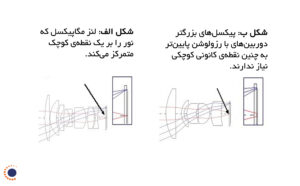
Using a standard resolution lens on a 5 megapixel camera will produce a blurry image. In most cases, if you want to use all the pixels provided by a multi-sensor camera, you will need a high-quality lens with a corresponding resolution, otherwise the money spent on a high-resolution camera will be wasted.
With that said, it might seem that all a person needs to determine a megapixel camera is to determine a megapixel lens. But it is not that simple, and in many cases it is difficult to ensure that the lens they need is the one provided. Many manufacturers market their products as “megapixel lenses”, but rarely do they provide a definition of the term “megapixel”. Is that “megapixel MP” lens going to be used in a 1.3 megapixel camera or a 3 megapixel camera? Can it be used in all megapixel cameras?
In megapixel cameras, the pixel size and spot size of the lens vary depending on the sensor size and number of pixels. For example, if you have two different cameras that are both 1.3 megapixels, if their sensor sizes are not the same, the pixel size will be different.
When choosing a lens, it is important to choose a lens that is designed for both the sensor size and the camera resolution. Choosing a lens with a higher megapixel count than the camera is acceptable. This will ensure that the lens is not the limiting factor in the resolution of the system.
Referring to Figures A and B, which were reviewed earlier, you would probably expect that cameras with different megapixels would also require different lenses. Cameras with higher megapixels and smaller pixels would require lenses that have more internal glass elements and higher precision elements compared to models with lower megapixels. These super lenses should meet the better performance that higher megapixel cameras require.
Flat lens vs. fisheye lens

In general, ultra-wide lenses can be categorized into two groups: flat lenses and fisheye lenses.
Most wide-angle lenses have barrel distortion (also known as fisheye distortion), which makes the image appear curved and convex in the center. Flat lenses, such as those made for the security and machine vision industries, keep lines that appear straight in the real world straight on the image sensor. The advantage of this type of lens is that it increases image resolution at the edges (in other words, when a subject is at the edge of the image, it will cover more pixels), while lenses with barrel distortion cause the image to be compressed at the edges and reduce resolution. With a regular wide-angle lens, potentially valuable information is lost in the lens, and no software, dewarping or anything else, can restore this lost image information. Dewarping can produce an image that is similar to that produced by a flat lens, but with a lower resolution. With a flat lens, the image is spread over a larger number of pixels at the edges, increasing the likelihood of detection and identification.
There are also cases where fisheye lenses can perform much better than straight-line lenses! With fisheye lenses, you can: focus on subjects from very close up, have a large and deep field of view when shooting wide-angle, and get close to large subjects with good color and sharpness.
With that said, it’s ultimately up to you to decide which type of lens best suits your needs and usage.
Taken from a&s magazine