
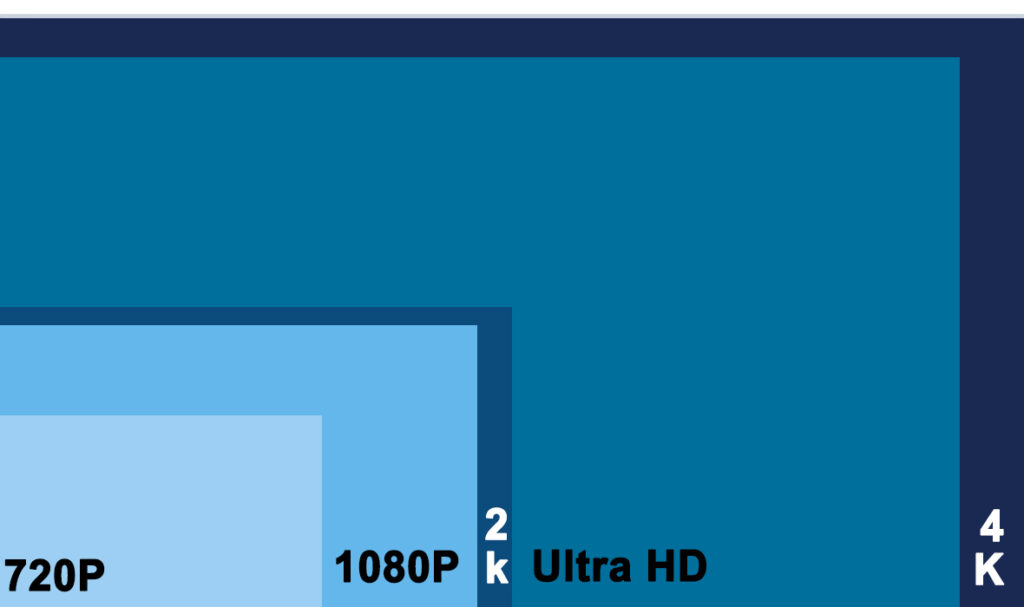
The term 4K refers to the resolution of the image, or in simpler terms, the size of your image. When it comes to screens and displays, resolution refers to the number of pixels that an image can display. This means how much detail that image has.
4K video has actually been around since the invention of the camcorder. It’s true that 4K video has been making a lot of noise, but keep in mind that 4K video files are significantly larger than their HD counterparts. That’s why loading and playing 4K videos can be a hassle for home viewers.
What is 4K video?
The term 4K, also known as UHD, was coined in the late 1990s when the film industry began using a digital video format. This video quality is the official standard for recording and playing back video on video cameras, projectors, and displays.
In addition to having more pixels, 4K defines the compression ratio, bit rate, and color depth of the video file. In addition to being trendy, the 4K video format actually has some advantages: from better presentation to more options for post-production.
What is the difference between 4K and 1080p?
As the name suggests, 4K UHD videos have a significantly higher resolution than 1080P HD videos. The resolution of 4K videos is exactly 2160 x 3840 pixels, while 1080P videos are made up of 1080 x 1920 pixels. … Comparing the quality of a 4K video to the quality of a 1080P video, it becomes clear that this huge difference brings significant benefits.
4K refers to the number of vertical lines that are present in the resolution of an image. The term is derived from 35mm film, which has approximately 4000 vertical lines. These old terms are used to refer to 16mm films, which are 2K, and IMAX films, which are a little over 8K.
4K videos have been around for over a decade, but they have only recently become affordable.
4K vs. UHD: What’s the difference?

The 4K cinematic format has to be 4,096 pixels wide, which is what “4K” means. But on the other hand, modern TVs only have 3,840 pixels vertically, which is technically not 4K and is Ultra HD.
Advantages of 4K Video Recording
Higher Image Quality
The 4K matrix creates a 3D image that can be viewed from all angles. In this image quality, there is no need to wear 3D glasses to see a high-quality 3D image. In addition, most cameras record 4K quality at a higher bit rate, and the loss of color quality in these images is as low as possible.
Stabilizing video images in real time
No matter how hard you try to keep still while shooting, 4K video can still be out of balance. Video editors can fix these disadvantages to some extent. But this type of processing will require frame cropping, which will lose at least 20% of your video.
Shooting in 4K will give you enough pixels to experiment with these effects, as it won’t have a drastic impact on the quality of the final video.
More editing options
The sheer resolution of 4K video gives you a much better source to work with, as it allows you to scale it up. It’s the best format for cropping videos for close-ups. With this type of footage, you can add effects like panning and zooming to any frame you want, without losing image quality.
A more attractive presentation on a larger screen
The high pixel count gives people high-quality images, or HD. Ultra HD images convey more colors and details in brighter and darker tones. All in all, it gives you an image that’s as close to reality as possible. The benefits of 4K images are best displayed on large screens, but compared to HD images, the quality of these images will be much higher even on smaller screens.
Are you looking to get a new 4K camera? Confused about what to look for? Contact us, we are here to help you.
Contact number: 02188535400