
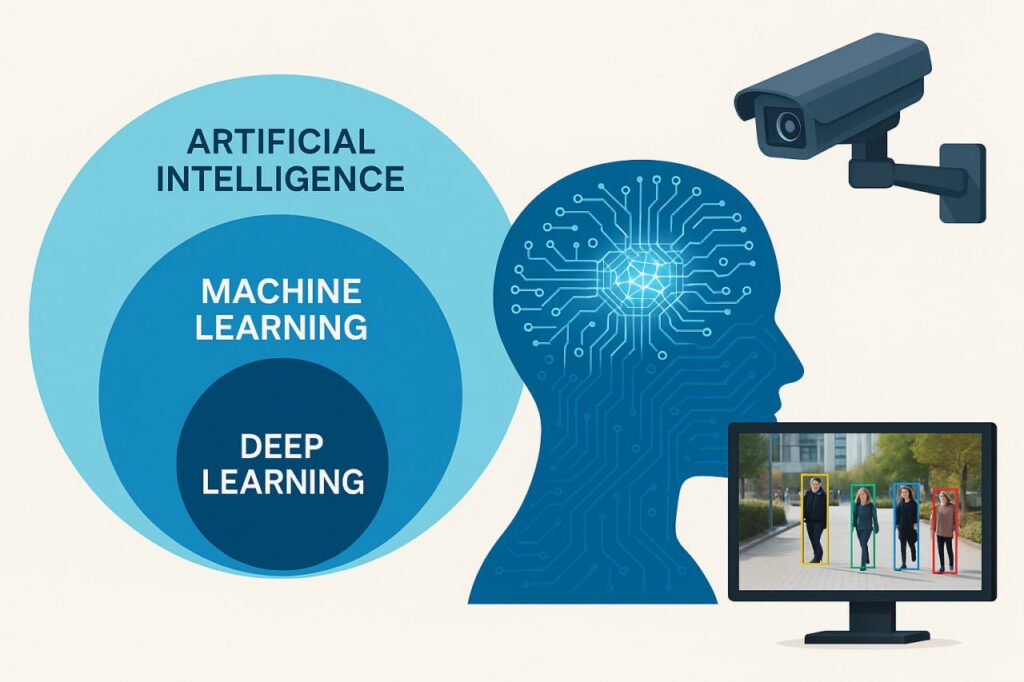
The term artificial intelligence was coined in 1956 by John McCarthy, who is known as the father of artificial intelligence. The idea behind artificial intelligence is simple and amazing. The goal of artificial intelligence is to create intelligent machines that can make decisions. It may seem like a science fiction, but with recent advances in technology and computing power, this idea is becoming more and more a reality.
As shown in the figure above, machine learning is a subset of artificial intelligence. This means that we can create intelligent machines that can learn from the data they are given. Furthermore, deep learning is a subset of machine learning that uses similar machine learning algorithms to train neural networks.
Artificial Intelligence and Its Impact on the World of Surveillance
The intelligent software paradigm is taking over the surveillance landscape, due to the pervasive nature of self-learning capabilities that are emerging in this space. In the past, surveillance meant tracking an individual’s movements. Governments around the world have invested heavily in installing and operating surveillance infrastructure. There are millions of surveillance cameras, but no one to monitor them 24/7. However, artificial intelligence (AI) is able to process every frame of recorded video and provide real-time analysis that could save millions of lives. Many countries are using advanced AI surveillance technologies to locate, track, and control individuals to serve a variety of policy objectives; some of these objectives are legal, some are related to human rights abuses, and others fall under a range of vague and unclear issues.
AI has a wide-ranging impact, and the reason for this is because of the technology’s self-learning capabilities. Initially, computers were trained to reason about the subjects in a scene. Now, the technology identifies subjects in the real world, matches the recognition results with the correct interpretations (provided by humans), and tries to improve further. In this way, the technology is constantly learning and improving. With each iteration, this error rate is minimized and gets closer to the level of human error, perhaps even better.
Now, let’s look at some important issues in the field of surveillance. Issues such as tracking people, area surveillance and monitoring, parking space management, vehicle analytics, and traffic monitoring are very important. Since the beginning of the Covid-19 crisis, many companies have devoted significant efforts to building AI-driven systems to ensure social distancing in public places. The pervasive nature of AI technology is leading to a level of sophistication that was unheard of in years past.
For example, for tracking individuals, video processing is performed in real time, analyzing and identifying suspicious events that could be considered a security threat to a company. Video analytics technology allows surveillance software to efficiently reason and identify unusual behavior and detect dangerous actions that might otherwise go unnoticed by human eyes.