
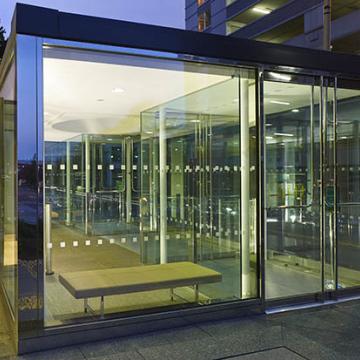
Currently, WDR surveillance cameras are mostly used in the banking and financial institutions industry. Other common applications include parking lots, large public squares, building entrances, toll booths and other spaces that are affected by varying light patterns and strong black light. High-quality WDR cameras are needed to provide detailed images in surveillance areas that are subject to constant light changes due to the changing seasons. These cameras will not only help police investigations, but also serve as evidence in the event of an incident.
The following are the main reasons why WDR cameras are used. End users from various sectors use WDR cameras to overcome the problems that BLC and Low-Lux cameras cannot solve.
Banks and Financial Institutions
In banks and financial institutions, surveillance cameras are often installed to provide timely surveillance footage of all customers, people and objects inside and outside the building, at entrances, main halls with full-length windows, parking areas for cash vehicles, entrances to underground parking lots and around ATM machines.
Highway toll booths
Currently, Low-Lux WDR surveillance cameras are widely used at highway toll booths to control traffic and money transactions. These cameras can effectively monitor the type of cars entering and the behavior of the toll collector, and analyze and record sudden events that may occur during the toll collection process. Collectors must be able to recognize the license plate of each car even in the dark, but under normal conditions, despite the headlights of the cars, the road light and the reflection of the light from the license plates, ordinary cameras will not be able to display accurately. As a result, such environments require WDR cameras.
Traffic Control
Surveillance cameras have improved the quality of surveillance in traffic control centers due to their ability to capture images of vehicles running red lights. These cameras have also played a significant role in issuing orders to mobilize resources when accidents and traffic incidents occur, and have improved vehicle inspections to prevent violations.
In addition, the video surveillance system enables comprehensive and coordinated road control in the monitored areas to optimize the use of road capacity. Also, in cases where 24-hour surveillance and ALPR/LPR are required, the use of Low-Lux WDR cameras is essential.
Commercial sectors and areas with strong lighting
Shopkeepers and shopping malls have specific applications that necessitate the need for network cameras. Since the interior decoration of these centers often includes reflective flooring, WDR will be needed to monitor the situation inside and outside the stores, the surrounding crowd, traffic flow, and safety conditions.
Installation and Setup Tips
Like any other camera, WDR cameras must be installed correctly to get the best performance. Users must also ensure that these cameras are used in the right environments. If you want WDR technology to use its full potential, keep in mind that the camera must be placed in real WDR conditions for its intended features to be activated.
WDR will be especially effective for entrances, coffee shops, and any other outdoor space with a strong light source. However, if you do not need wide dynamic range for a particular scene, it is better to turn it off, as this feature can lead to a reduction in some camera performance characteristics, such as sensitivity.
Once the camera is installed, its contrast enhancement settings can increase the display details in the dark parts of the scene and in the dynamic range. Basically, with WDR cameras, all lighting conditions are covered, and therefore it would be unreasonable to change the viewing angle to achieve better results. Basically, if the results improve by adjusting the viewing angle, this means that the camera does not have a wide dynamic range.
Future Outlook
With the presence of a diverse range of users, the technology and categories of cameras are also changing. WDR technology is one of the main factors that shows the potential for technology development and drives this development for camera manufacturers. In the near future, image sensors that support the WDR feature will be offered with higher resolutions, and as a result, the current megapixel WDR image sensors will be able to provide higher quality images and perform much better in low light conditions. In addition, the image resolution in multi-view mode will be improved, even with people or moving objects in the scene. ISP will be upgraded to match WDR with various applications and will provide higher quality images by reproducing true colors.
WDR technology has developed rapidly in the last few years. The dynamic range has become wider and now there are even technologies such as CCD DSP or dual-speed shutter. Today, all WDR cameras use DSP streams, which allows for clear display of objects in the darkest areas of the scene.
For WDR to overcome its current obstacles, costs must be reduced. If in the future, the production cost of WDR cameras becomes equal to that of conventional cameras,